Success Is Mostly Luck — So I'm Betting on AI
What building automated AI agents taught me about luck, control, and the limits of parallelization

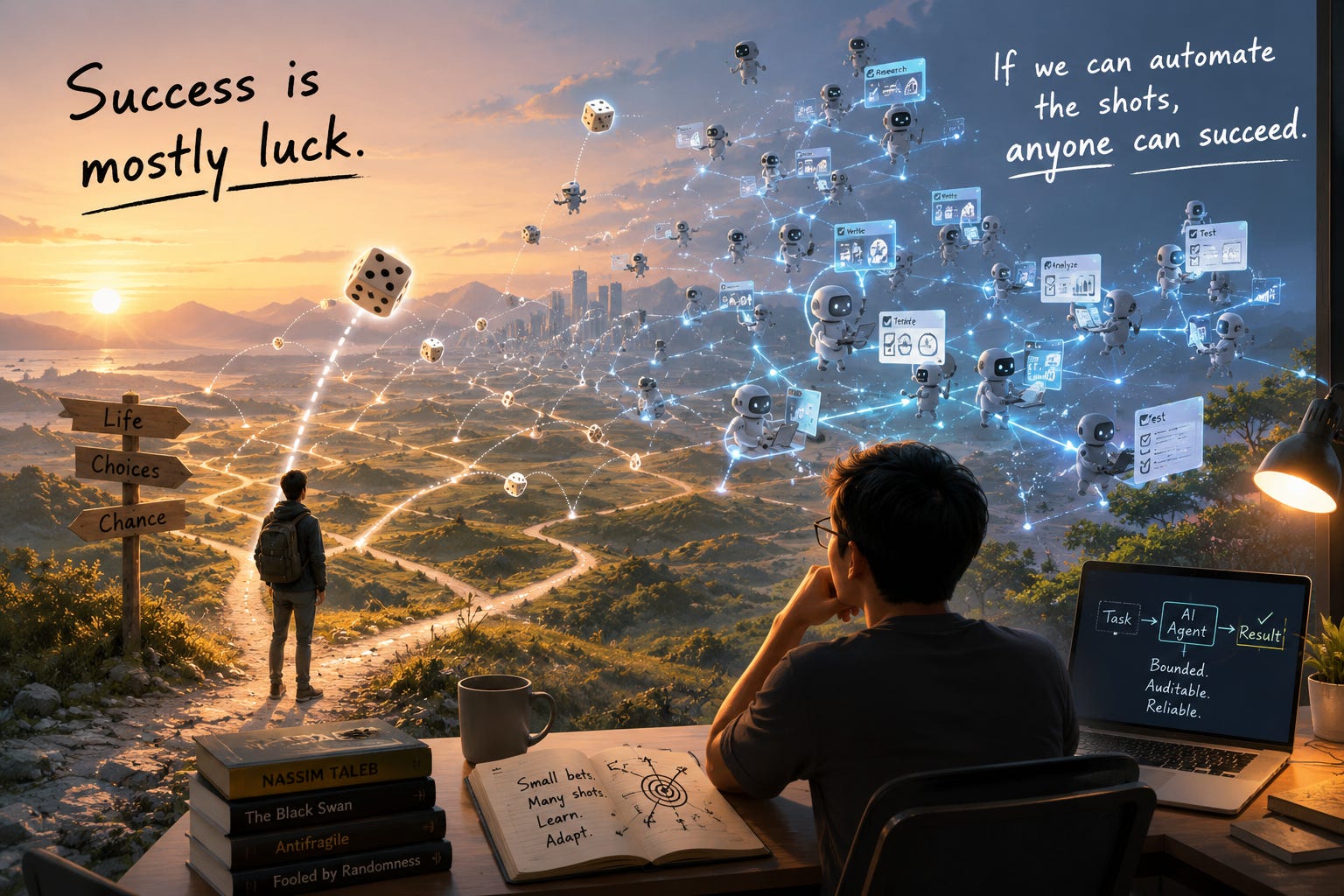
After reading several of Nassim Taleb’s books, I have become increasingly convinced that success — by almost any definition — is driven mainly by luck. When I reflect on my own trajectory, only a handful of events have truly changed the course of my life. The same seems true of the world at large: just a few pivotal moments reshape everything. I’m not even sure I could live my life again and end up where I am now.
If luck is the key ingredient, then the obvious lever is to take more shots on goal. Without limits on computational capacity, we might be able to speed that process up and reach success in far less time. That’s why I try to build automated AI agents and parallelize as much of the work as possible.
Along the way, though, I discovered that today’s AI still needs a lot of cultivation to reliably do the right thing over the long term. The longer you let the agents run, and the more you parallelize, the harder it becomes for a human to audit and steer their behavior. So for now, I’ve stepped back toward more isolated, bounded subtasks. I focus on cultivating specific skills well, so that the AI parallelizes within a single, well-defined task rather than across an entire end-to-end workflow.
I hope this changes in the future. Because if success really is mostly luck, then AI that can take those shots for us might mean anyone can succeed at whatever they set out to achieve.